
Introduction
Organizations today face immense pressure in the current digital age to innovate faster, scale more efficiently, and cut down on operational expenses. The current on-premise infrastructure faces challenges in meeting these requirements because of the inherent lack of scalability, maintenance costs, and the time taken for deployment. This is where cloud migration becomes more of a strategic imperative than a technology one.
Cloud migration refers to the process of moving applications, data, workloads, and IT resources from on-premises or legacy environments to cloud platforms such as Amazon Web Services (AWS), Microsoft Azure, or Google Cloud Platform (GCP). However, successful cloud migration is not merely about shifting data—it is about transforming how organizations operate, innovate, and deliver value.
Why Cloud Migration Is Essential
Organizations migrate to the cloud primarily to overcome the limitations of traditional infrastructure. On-premises systems require heavy upfront investment in hardware, continuous maintenance, and dedicated operational teams. Scaling these systems during peak demand is complex and costly, often leading to underutilized resources during off-peak periods.
Cloud platforms address these challenges by offering on-demand scalability, pay-as-you-go pricing, and managed services. Businesses can rapidly deploy applications, scale resources automatically, and focus more on innovation rather than infrastructure management. Additionally, cloud providers offer built-in high availability, disaster recovery, and global reach, which are difficult and expensive to achieve on-premises.
Cloud Migration Strategies:
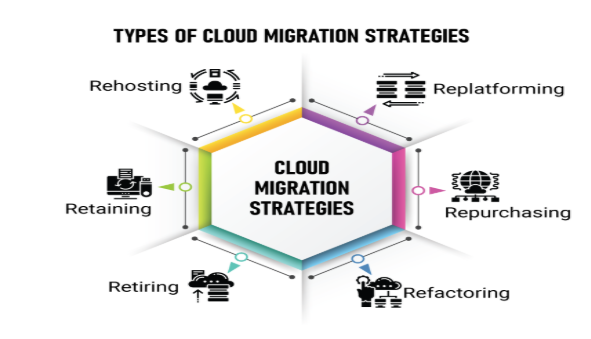
Cloud migration strategies define how applications and workloads move to the cloud and how much modernization is involved. Organizations select different strategies based on business goals, technical complexity, and risk, often using multiple approaches across workloads rather than a single method.
Rehosting
Rehosting moves applications to the cloud with minimal or no changes. It is the fastest approach and is ideal for quick migrations or data center exits, though it offers limited cloud optimization and often requires post-migration tuning.
Replatforming
Replatforming makes minor adjustments to use cloud-managed services without changing the core architecture. It improves performance and efficiency while maintaining a balance between effort and cloud benefits.
Refactoring
Refactoring redesigns applications to be fully cloud-native, using architectures like microservices or serverless. It provides maximum scalability and flexibility but requires higher time and investment for long-term value.
Repurchasing
Repurchasing replaces existing systems with cloud-based SaaS applications. This reduces maintenance effort and speeds up access to modern features when SaaS solutions meet business needs.
Retiring or Retaining
Retiring removes out-dated or low-value applications to reduce cost and complexity. Retaining keeps certain workloads on existing systems due to business, technical, or regulatory reasons, with periodic review for future migration.
Cloud Migration Isn’t about the Cloud- It’s About Decisions
When people hear cloud migration, they often imagine servers magically moving into the cloud with a few clicks.
“The reality is very different”
Cloud migration is not a technical activity. It’s a series of business decisions – made under pressure, deadlines, budgets, and risk.
I learned this while studying how real organizations migrate to the cloud. Not everyone modernizes. Not everyone rewrites. And surprisingly, not everything moves to the cloud.
This blog walks through the real stories behind cloud migration strategies, not as definitions – but as decisions companies make when it actually matters.
The First Decision: Rehosting

Imagine a company with its own data center. The servers are old. Maintenance costs are rising. A contract renewal is due in three months. There is no time for redesign. No budget for experimentation. So the company chooses the simplest path: move everything as it is. This is Rehosting.
Applications are lifted from on – premises servers and placed into cloud virtual machines. Same code. Same architecture. New location.
A retail organization once did exactly this – moving its inventory and billing systems straight into AWS EC2. Nothing fancy. The goal wasn’t optimization. The goal was survival.
Rehosting is not a failure. It’s often the first step forward, buying time to think clearly.
The Second Decision: Replatforming

Once systems are running in the cloud, a new thought appears:
“What if we stop managing everything ourselves?”
This is where Replatforming begins. The application stays mostly the same, but parts of it are handed over to the cloud. Databases move to managed services. Storage shifts to cloud-native options. Scaling becomes automatic.
An e-commerce company did this when it moves its application servers to cloud but replaced its self-managed database with Amazon RDS. No rewrite. No big risk. But suddenly, backups, patching, and scaling were no longer manual tasks.
Replatforming is a quiet improvement. It doesn’t make headlines—but it reduces stress, effort, and long-term cost.
The Third Decision: Refactoring

Here comes the hardest realization. The system works-but it can’t grow. Every new feature breaks something. Traffic spikes cause outages. Deployment takes weeks. The architecture it self has become the bottleneck. This is when organizations choose Refactoring.
They don’t move the application.
They rebuild it.
“Monoliths become microservices.
Servers disappear into serverless.
Scaling becomes automatic.”
Netflix faced this exact challenge. Their old architecture couldn’t support global streaming at scale. So they redesigned everything around cloud-native principles-and changed the future of streaming forever. Refactoring is expensive. It’s slow. It’s risky. But for companies with big ambitions, it’s the only path forward
The Fourth Decision: Repurchasing

Sometimes, the smartest move is not to migrate at all.
Many companies look at their internal systems and ask a simple question :
“Should we really be maintaining this?”
That’s where Repurchasing comes in. Instead of migrating an old HR or CRM system, companies replace it with SaaS tools like Workday, Salesforce, or ServiceNow. One enterprise shut down its internally built HR platform and moved fully to a SaaS solution.
No servers. No upgrades. No maintenance. Just a login.
Repurchasing is not giving up control—it’s choosing focus.
The Final Decision: Retiring or Retaining

Not everything deserves a migration. During assessments, organizations often discover:
- Applications no one uses
- Reports no one reads
- Systems kept alive “just in case”
This is Retired.
And then there are systems that must stay-mainframes, regulatory workloads, or deeply embedded legacy platforms. Banks often retain core systems on-premises while modernizing everything around them. Cloud migration is not about moving everything.
It’s about moving what matters.