
MySQL to ClickHouse with Continuous CDC
Quick answer: a local MySQL events table with 5,000,001 rows was loaded into a managed ClickHouse server in about 3 minutes 23 seconds, then kept current with binary-log-based CDC. A Python agent reads the snapshot in keyset-paginated batches and streams changes outward over HTTPS—without exposing MySQL publicly.
Last updated: September 2026
The objective was not just an initial transfer. We needed a repeatable pattern for loading history, continuing to deliver inserts, updates, and deletes, and presenting an up-to-date reporting view in ClickHouse.
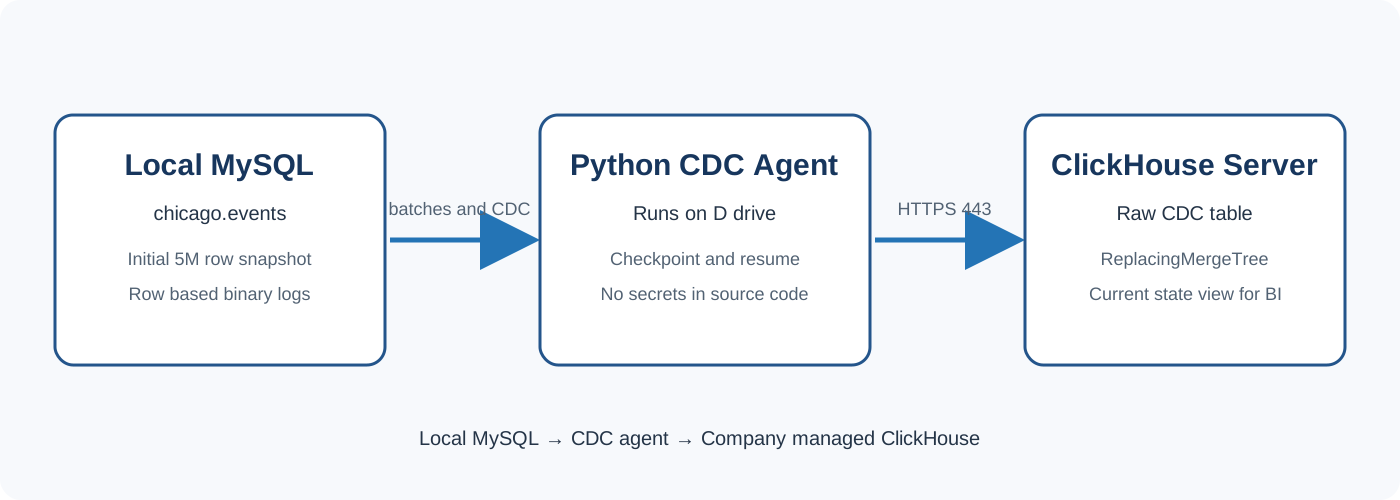
The architecture
A Python CDC agent runs next to MySQL. It reads an initial snapshot in primary-key batches, then consumes row-based binary logs for inserts, updates, and deletes. The agent pushes to ClickHouse over HTTPS on port 443, so MySQL needs no public tunnel or inbound firewall rule.
This is a useful pattern for a company-managed ClickHouse server. For ClickHouse Cloud, ClickPipes is the managed choice; a local agent is useful when the source is local and the target is an owned server.
1. Prepare MySQL for CDC
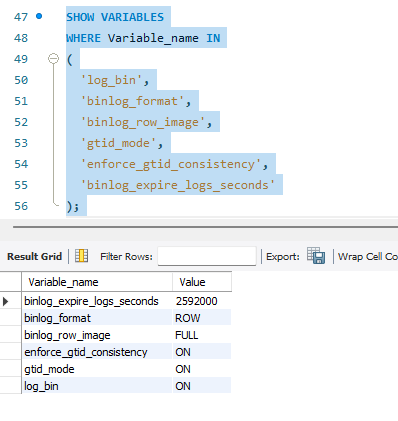
MySQL CDC relies on row-based binary logs. We verified the configuration before starting:
SHOW VARIABLES WHERE Variable_name IN
('log_bin', 'binlog_format', 'binlog_row_image',
 'gtid_mode', 'enforce_gtid_consistency',
'binlog_expire_logs_seconds');| Setting | Required value | Why it matters |
|---|---|---|
log_bin | ON | Makes changes available to the CDC reader. |
binlog_format | ROW | Captures inserts, updates, and deletes as row events. |
binlog_row_image | FULL | Provides reliable before/after row images. |
gtid_mode | Recommended | Improves production recovery options. |
The CDC user needs SELECT, REPLICATION SLAVE, and REPLICATION CLIENT privileges. In production it should be a dedicated least-privilege user.
2. Model CDC data in ClickHouse
Rather than writing directly to a reporting table, the pipeline stores versioned records in a raw CDC table. ReplacingMergeTree retains a version number and deletion marker, while a current-state view is used by dashboards.
CREATE TABLE <database>.mysql_chicago_events_cdc
(
    event_id UInt64,
    event_time DateTime64(3),
    user_id UInt64,
    event_name LowCardinality(String),
    product String,
    amount Decimal(13, 2),
    region LowCardinality(String),
    _cdc_version UInt64,
    _is_deleted UInt8
)
ENGINE = ReplacingMergeTree(_cdc_version)
PARTITION BY toYYYYMM(toDate(event_time))
ORDER BY event_id;
3. Run the snapshot and CDC agent
The agent uses clickhouse-connect, pymysql, and mysql-replication. Connection settings are supplied through environment variables only. Keyset pagination with a 50,000-row batch size reads in event-ID order instead of repeatedly scanning earlier rows.
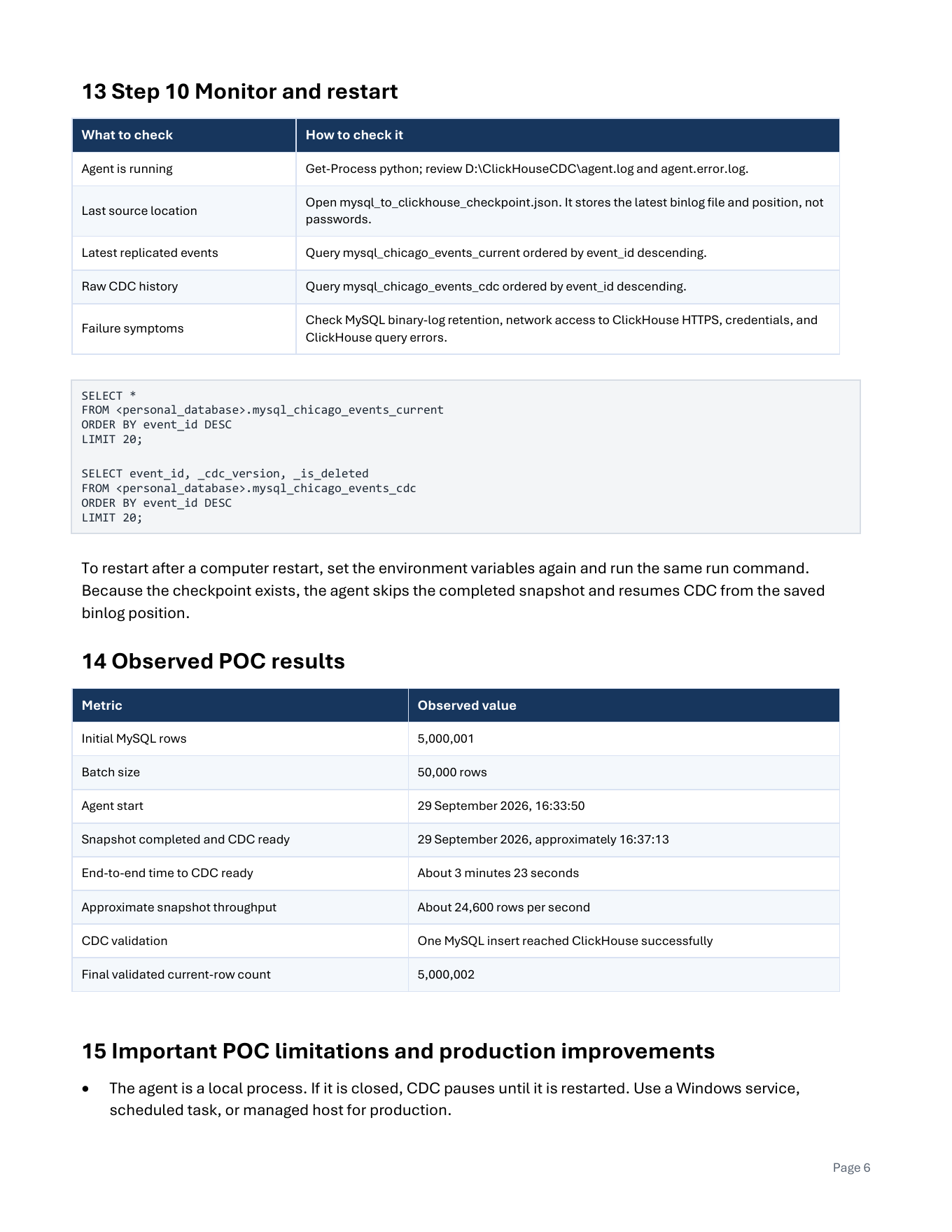
After the snapshot, the agent saves the last copied event ID and MySQL binary-log position. On restart, it resumes CDC rather than reloading history.
Results
| Metric | Result |
|---|---|
| Initial MySQL rows | 5,000,001 |
| Batch size | 50,000 rows |
| Time to CDC-ready | About 3 minutes 23 seconds |
| Approximate throughput | About 24,600 rows per second |
| CDC validation | One new MySQL event arrived successfully |
| Final current-row count | 5,000,002 |
Production considerations
This was a successful POC, not a final production design. Before using this pattern for critical workloads, add a managed service or host for automatic restarts, vault-backed secret storage, replication-lag and agent-health monitoring, a consistent snapshot strategy, retries, schema-change handling, alerts, and an operational runbook.
Frequently Asked Questions
Is this pattern suitable for ClickHouse Cloud?
For ClickHouse Cloud, ClickPipes is the managed option for connectivity, checkpoints, and operational recovery. The local-agent model is useful when the destination is a company-managed server.
Why use a CDC table and current-state view?
The raw table retains versions and deletion markers for troubleshooting. Dashboards query a filtered current-state view.
Does the MySQL database need to be public?
No. The agent runs near MySQL and sends data outward over HTTPS, so MySQL does not need an inbound public connection.